
Combining elements of cooking from northern Anhui, south-central Anhui, and the Hui-speaking areas of southern Anhui, Anhui cuisine is known for its use of wild game and herbs, both land and sea, and comparatively elaborate methods of preparation.
Braising and stewing are common techniques. Frying and stir-frying are used much less frequently in Anhui cuisine than in other Chinese culinary traditions. Anhui cuisine consists of three styles: Yangtze River region, Huai River region, and southern Anhui region. Anhui has ample uncultivated fields and forests, so the wild herbs used in the region's cuisine are readily available. Here lists famous dishes of Anhui Cusine as below:
Li Hongzhang Hodge-Podge
It is a popular dish named after Anhui's Li Hongzhang, who was a top official of the late Qing Dynasty (1644-1911). The dish, a complex soup, is somewhat salty with a hint of sweetness. Many types of ingredients can be used in the dish but the most common include sea cucumber, fish, squid, bamboo, dry bean curd, chicken, ham, and assorted vegetables.
Luzhou Roast Duck
It is a popular dish from the the provincial capital Hefei, which first gained renown when it was given in tribute to the Imperial Court. While not nearly approaching the world wide fame of Peking Duck, Luzhou Roast Duck has won awards and distinction within China.
Sanhe Shrimp Paste
It is a regional dish that originated in the ancient city of Sanhe, but can currently be found in neighboring Hefei. The dish's main components are rice flour and a regional species of small white shrimp. The shrimp are stir fried with leeks and soy sauce, meanwhile the rice flour is soaked in water and later added to the shrimp.
Egg Dumplings
These dumplings usually associated with rural cooking, use thin sheets of egg instead of flour for the wrapping. Egg dumplings traditionally use pork as a filling. In preparation a ladle is lightly coated with oil and heated, well beaten eggs are spooned into the ladle and cooked until the egg mixture forms into a dumpling wrapper. The pork filling is then spooned into the egg wrapping and finally it is steamed. It is often served with soy sauce.
Wushan Imperial Goose
The history of Wushan Imperial Goose dates back more than 1,000 years to the Tang Dynasty. The dish is light in color while it is fragrant and salty in taste.
Huizhou Moldy Tofu
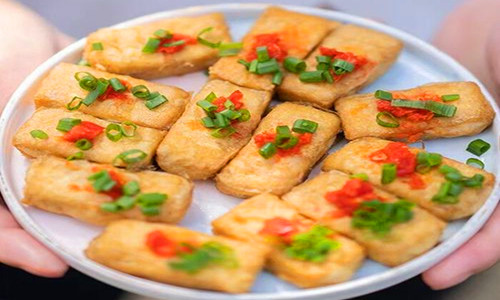 It is a traditional fermented soy product from the Huizhou region of Anhui Province, and is recognized as a provincial-level intangible cultural heritage. It is made from tofu as the base material, which undergoes natural fermentation to form inch-long white fluffy mold hyphae, rich in amino acids and vitamin B2. The traditional preparation method involves cutting the tofu into pieces, fermenting them, frying them until both sides are golden brown, and then braising them to allow the flavors to penetrate. Seasoned with spicy sauce and chopped scallions, it forms a unique flavor of crispy exterior and tender interior, salty and slightly spicy.
This dish is said to be related to the story of Ming Taizu Zhu Yuanzhang, who was defeated in battle and ate fermented tofu in Huizhou. Now it has become a symbol of homesickness for Huizhou natives. The most culturally rich scene is encountering a street vendor with a bamboo pole, one end holding a charcoal stove warming an oil pot, and the other end neatly stacked with hairy tofu. The tofu is fried on the spot and served with sesame oil and chili paste. Diners can eat while walking, enjoying the street atmosphere amidst the smoke and fire. The finished product must meet the "tiger skin hairy tofu" standard. It can be purchased in scenic spots such as the ancient city of Huizhou and Tunxi Old Street, as well as in food markets