
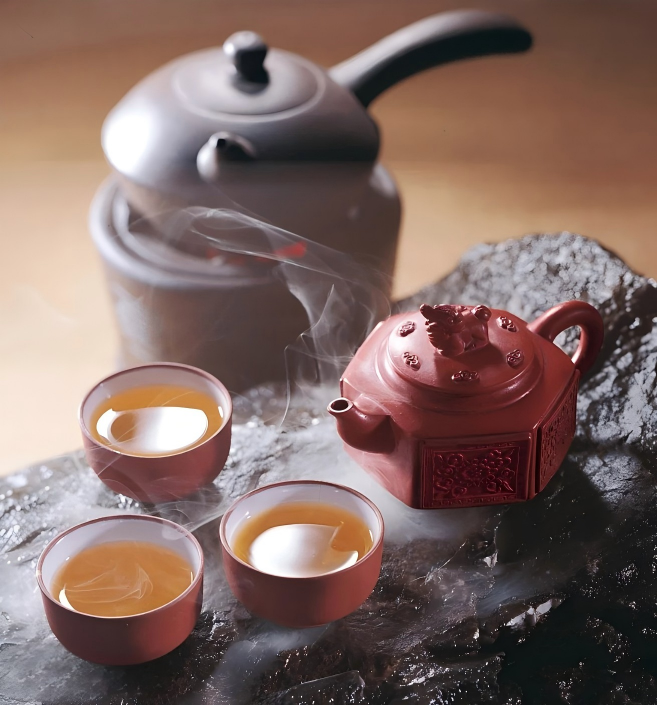
Zisha teapots are uniquely Chinese handmade clay crafts, originating in Dingshu Town, Yixing, Jiangsu Province during the Zhengde reign of the Ming Dynasty. They are crafted from local purple clay. The craftsmanship dates back to the tree gall teapots created by Gongchun. Firing at 1100-1200°C creates a double-layered pore structure, allowing air to pass through without leaking water, and retaining fragrance without dissipating. Zisha clay is high in iron, sourced from Huanglong Mountain and surrounding mining areas. Composed of quartz, mica, and clay minerals, these natural minerals combine practical functionality with artistic value.
Zisha teapots are categorized into plain, flowered, and ribbed patterns. Their production requires traditional techniques such as body beating and inlaying. Famous artists throughout history, including Shi Dabin of the Ming Dynasty, Chen Mingyuan of the Qing Dynasty, and Gu Jingzhou of modern times, often incorporate elements of calligraphy and seal carving into their works. In 2015, a Gu Jingzhou teapot with a squirrel and grapes design fetched 92 million yuan at auction. Due to the scarcity of clay materials, Yixing implemented a ban on purple clay mining in 2005, and the traditional craft was listed as a national intangible cultural heritage.