
Huishan Ancient Town Scenic Area is located north of Xihui Park in Wuxi. It was formed by the merger of the original Xihui Park (Xihui Scenic Area) and the Huishan Historical and Cultural Block. From a regional functional perspective, it is divided into four tourist areas: cultural relics and historic sites, Xihui Scenic Area, historical and cultural block, and forest protection zone. The scenic area covers an area of 3.5 square kilometers, with a core area of 1.09 square kilometers.
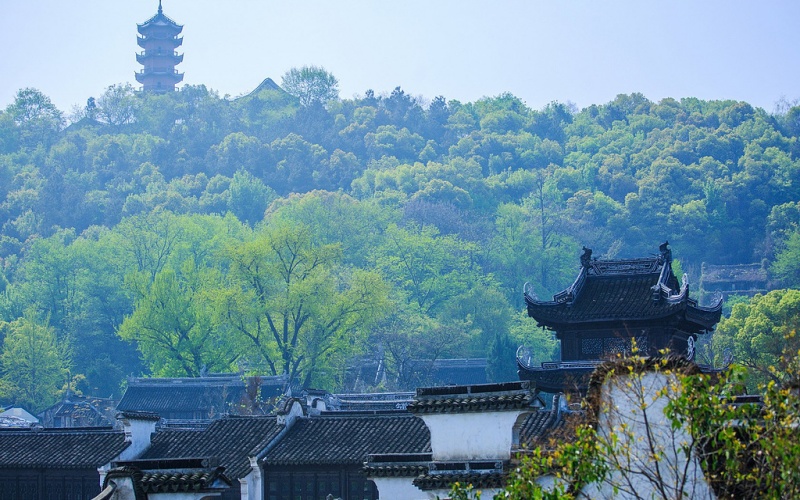
Xihui Park (Xihui Scenic Area) is a national key park, also known as Xihui Scenic Area, and a national key scenic spot; Huishan Historical and Cultural Block is a municipal level historical and cultural block in Wuxi, and Huishan Old Street has been rated as a famous historical and cultural street in China; The Huishan Temple Group is on the tentative list of China's World Cultural Heritage sites. The temple complex was first built in the Tang Dynasty and flourished in the Ming and Qing Dynasties. What we see now are mostly Qing Dynasty temples. These ancestral halls involve more than 80 surnames, why not trace and ask your ancestors here. In addition, the Wuxi clay figurines in town are good souvenirs and the delicious food is also worth tasting.

Huishan Ancient Town Scenic Area boasts numerous cultural relics and historic sites, as well as excellent mountains, waters, forests, and springs. There are over 200 scenic spots and attractions, as well as various traditional cultural resources such as ancient streets, gardens, temples, springs, academies, poetry societies, and ancestral halls, spanning thousands of years of history. The so-called Tang, Song, Yuan, Ming, and Qing dynasties can be traced back to the present day. Among them, there are 23 and 44 cultural relics protection units at or above the city level, known as Wuxi Open Air History Museum and Wuxi People's Spiritual Home.
Famous attractions include the Liangzhu Xishan Ancestral Site, the place where Chunshen Jun drank horses during the Warring States period, the Huishan Temple Garden during the Northern and Southern Dynasties period, the Tang Dynasty's Second Spring, the Song Dynasty's Jinlian Bridge, the Ming Dynasty's Ancient Garden Jichang Garden, Yugong Valley, the Ming Dynasty's Erquan Academy and Bishan Yin Society, as well as 118 ancestral halls and gardens from the Tang Dynasty to the Republic of China, Erquan Yingyue and Abing Cemetery. There is a botanical garden - China Rhododendron Garden. There are azaleas in spring and chrysanthemums in autumn, with fragrant flowers blooming throughout the four seasons. Huishan Old Street showcases the charm of the ancient water town at the foot of the Jiangnan Mountains, with outstanding people and a beautiful land. People come here to seek their roots and worship their ancestors, and to pay close attention to the distant future. Huishan clay figurines and Huishan temple fair reflect the local customs and traditions of Wuxi.
Huishan Ancient Town is surrounded by a north-south horizontal street and an east-west straight street (Xiuzhang Street). At the east end of the straight street, there is a large ancient town wall with the four big characters "Huishan Ancient Town" written on it, which is very easy to recognize; The northern end of Hengjie, at the intersection of Huiqian Road and Tonghui West Road, is the ticket point. The cross street and the direct intersection are adjacent to the Guhua Mountain Gate and Xiuzhang Gate of Xihui Park. There are outstanding memorial archway in the north. The spring on Huishan flows into the water bearing well behind the memorial archway, and the Longtou River flows into the Grand Canal from southwest to northeast.

Temples are mainly concentrated along the Longtou River and on straight streets, with slightly fewer temples on horizontal streets. Apart from the attractions that can be visited inside on the ticket, many ancestral halls are not open and can only be viewed outside. There are introduction signs at the entrance of the ancestral halls. Most of the ancestral halls are typical Jiangnan architecture, with white walls and black tiles, wooden doors and windows, and some come with small gardens. The Yang Oufang Temple is quite unique, incorporating Western architectural styles, resembling a stone warehouse door made of bricks and stones.
Along the banks of the Longtou River, from southwest to northeast, there are Qianlu (Liugeng Grass Hall), Wuxi Intangible Cultural Heritage Exhibition Hall, Yang Youfang Temple, Lianxi Zhou Fuzi Temple (Guangji Temple, Zhou Lianxi refers to Zhou Dunyi who wrote "Love Lotus"), and Huishan Garden (Li Gong Temple, Li Gong is Li Hongzhang's brother Li Hezhang). You can reach Mr. Gu Dongyang Temple (Gu Kejiu Temple) from the path behind the Yangoufang Temple. There is a tall the Taihu Lake Lake stone in the garden of the temple. The attractions that require admission tickets on the straight street, from west to east, are Mr. Ni Yunlin Temple, Fan Wenzheng Temple, Lu Xuan Temple, and Xu Ruzi Temple.

The most northeast scenic spot along the Longtou River is the Chinese Clay Figure Museum, and admission tickets must also be presented. Inside the museum, you can see both the Southern style Wuxi Dafu and the Northern style clay figurine Zhang, as well as the process of the master making clay figurines. If you like, you can buy Wuxi clay figurines in the museum, and of course, you can also find clay figurines by strolling around the ancient town outside the museum.
If you pursue a petty bourgeois atmosphere, the banks of Longtou River are shaded by green trees and lined with colorful umbrellas. Sitting at a table under a parasol, drinking coffee or ordering a pot of tea, the gentle breeze blowing by the riverbank is incredibly pleasant. The Pioneer Bookstore in Nanjing has opened a branch in the ancient town (186 Xiuzhang Street), with wooden flower windows filled with artistic tones.
The cuisine of the ancient town is also not to be missed, and Huishan Tofu Flower (No. 13 Heng Street) often queues up; Not far from it, Xiaolongbao in the Memory of Qin Garden is said to have been on "China on the Tongue". Crab meat dumplings are the signboard; Old Restaurant (No. 3 Xiuzhang Street) specializes in exquisite Wuxi cuisine; The Su style noodles on the one acre three fen field (No. 24 Xiuzhang Street) are very impressive. Pastry cakes are a unique feature here. Just a few steps away from the ancient town, you can see a pastry shop where you can buy and eat while strolling.
Huishan Ancient Town and Xihui Park can be visited together, with famous attractions such as Jichang Garden and the second spring in the world that gave birth to the famous erhu song "Er Quan Ying Yue".
Travel Tips
Address: No. 18 Baoshan Street, Liangxi District, Wuxi City, Jiangsu Province
Telephone: 0510-83333833
Opening Hours: 08:00-17:30
Admission ticket: CNY190