
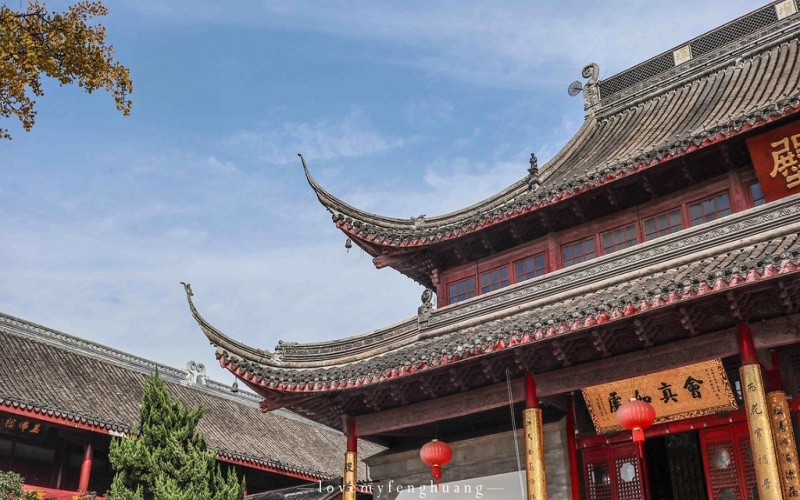
Located at the foot of Qixia Mountain, Qixia Temple is the essence of Qixia Mountain Scenic Area in Nanjing. The temple was first built in the Southern Dynasties, and the historical sites inside the temple include the Ming Zheng Jun Stele, the Pagoda of Relics, and the Thousand Buddha Rock, which resembles a miniature version of the Yungang Grottoes.

During the Red Maple Festival, red maple trees, ginkgo trees, ancient temples, and autumn colors blend together, creating a beautiful scene like a painting. The temple is arranged in the east-west direction of the main building of the temple.
The gate, namely the Heha Hall, is at the west end, with a vertical plaque of "Sheshan Qixia Temple" (Qixia Mountain is also known as Sheshan). Walk through the stone memorial archway outside the scenic spot, which reads "Qixia Temple", to the gate, which is also the gate of the whole Qixia Mountain.
From west to east, visit Mingjing Lake (Rainbow Mingjing) with a statue of Guanyin in the middle, the bell towers and drum towers located on the north and south sides of the road, the crescent shaped pool, and then proceed to the main halls. Behind the crescent shaped pool is the Maitreya Hall, and the small pavilion on the north side is easy to overlook.
 |
 |
You must go and take a look. Inside is the Mingzheng Jun Stele, which was erected in memory of the founder of the temple, Ming Sengshao. It is one of the few remaining Tang Dynasty cursive script steles in China.
 The first part of the monument is a 6-dragon arch forehead, with the four characters "Mingzheng Jun Stele" in seal script. It was written by Tang Dynasty calligrapher Wang Zhijing, and the two sides of the monument are decorated with a lion's head and a ribbon of passion flower. The inscription was drafted by Tang Emperor Gaozong Li Zhi and inscribed by calligrapher Gao Zhengchen in cursive script. The entire text is 2376 words, consisting of four or six rhymes, and ends with 10 nouns.
There are other buildings in the Jade Buddha Tower Temple, including the scripture storage building; The Jade Buddha Tower, inside which the Jade Buddha was donated by Master Xingyun, the founder of Fo Guang Mountain.
The Jianzhen Memorial Hall (also known as the Cross Sea Master Memorial Hall) dedicated to the statue of Jianzhen. The Pagoda of Relics is located not far east from the Piringbao Hall. It was first built in the second year of Renshou in the Sui Dynasty (602 AD) and rebuilt in the Southern Tang Dynasty.
The stone pagoda has 5 floors and is 18 meters high. Pay attention to the reliefs on the pedestal and tower, which are exquisitely carved with various bodhisattvas and Buddhist stories. Qianfo Rock is adjacent to the Pagoda of Relics and was first excavated during the Southern Qi Dynasty. Buddha statues are carved in caves along the mountain walls, with the larger one located in the Great Buddha Pavilion, also known as the Three Holy Temples or the Infinite Hall. It is also one of the earliest grottoes excavated in Qianfo Rock, and the Infinite Life Buddha statue inside is over ten meters high.
In Cave 102, you can see the graceful flying celestial statue, which echoes the Dunhuang Flying Apsaras and is called the "Eastern Flying Apsaras". Interestingly, there is also a stonemason statue holding an iron hammer and cone in the latter grotto. If you are interested, you may want to look for it.
Travel Tips
Address: No. 84 Qixia Street, Qixia District, Nanjing City
Telephone: 025-85761831,025-85766979
Opening Hours: 8:00-16:30 throughout the year
Admission ticket: CNY 30