
Zhongyue Temple is located about 3 kilometers east of Dengfeng City, at the foot of Huanggai Peak on the eastern slope of the Taishi Mountain. Its predecessor was the Taishi Temple, which was built in the Qin Dynasty (221-207 BC) as a place for worshipping the Taishi Mountain God. The existing structure basically retains the scale after the Qing Dynasty's reconstruction, and it is a relatively well preserved ancient architectural complex in Henan Province.
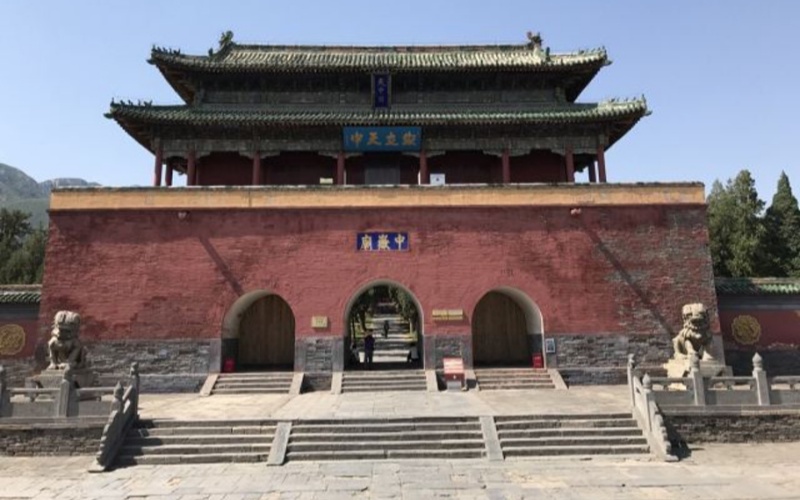
It is very convenient to travel from Dengfeng City to Zhongyue Temple, with direct buses available. Zhongyue Temple adopts the traditional axisymmetric architectural style, and visitors can walk along the central axis to enjoy the scenery.
What To See
On the central axis, there are memorial archway, Remote Reference Pavilion, Chongsheng Gate, Junji Gate, Zhongyue Hall, Imperial Library and other buildings, among which Zhongyue Hall is magnificent.

In the pavilions on both sides of the gate of Zhongyue Temple, there are two stone pedestals named "Weng Zhong" (a type of deity statue). Weng Zhong was erected in the fifth year of Emperor An of the Eastern Han Dynasty (118 AD) and has a history of nearly two thousand years.
After passing through the memorial archway, you will see an octagonal pavilion - the Far Reference Pavilion. From here, you will pass through the Tianzhong Pavilion and the Chongsheng Gate and enter the second courtyard.

At the four corners of the Shenku on the east side of the Second Entrance Courtyard, there are four iron men from the Song Dynasty who were cast in the Zhenku area. Each iron man weighs about four tons and has a brave and powerful appearance. It is one of the well preserved and early unearthed iron men in China.
On both sides of the courtyard, there are two stone tablets that record the history of the reconstruction of the Zhongyue Temple. Among them, there are three Song steles and one Jin stele. The inscriptions on the four steles are all inscribed by the top scholars of the time, hence they are also known as the "Four Top Scholars Stele".
On the east side of the "Junji Gate" ahead, there are three stone tablets. Among them, the "Monument to the Song Gao Ling Temple in Zhongyue" is very precious. It was carved in the second year of Tai'an in the Northern Wei Dynasty (456 AD) and is an ancient stone tablet preserved in the Songshan area. The calligraphy on the tablet is beautiful and is a classic example of Wei stele style. Over the past thousand years, it has been continuously rubbinged, and the inscription has become somewhat blurry.
The main building of Zhongyue Temple - Junji Hall, also known as Zhongyue Grand Hall. The horizontal plaque inside the main hall reads' Weiling Zhenyou ', which was inscribed by Emperor Xianfeng of the Qing Dynasty.
The Panlong coffered ceiling on the top of the main hall is exquisitely carved and decorated with splendor. The pair of iron lions in front of the palace, cast in the second year of the Zhengda reign of the Jin Dynasty (1225 AD), are exquisite cultural relics of the Jin Dynasty.

On the west side of the central axis, there is the "Ancestral Hall", and on the east side, there is the "Three Immortal Palace". The iron lion outside the gate of the Three Immortal Palace is a cultural relic cast during the Wanli period of the Ming Dynasty (1573-1620 AD), comparable to the Jin Dynasty iron lion in front of the Zhongyue Grand Hall.

The ancient trees in the scenic area are towering, with more than 300 ancient cypresses, many of which are said to have been planted before the Han Dynasty, which is also a major feature of Zhongyue Temple.
Travel Tips
Address: No. 818, East Section of Shaolin Avenue, Dengfeng City, Zhengzhou City
Telephone: 18595619933
Opening Hours: 8:00-18:00
Ticket: CNY 30