
Dunhuang is a county-level city under Jiuquan City of northwest China's Gansu Province, but it is one of the top destaination of Gansu because it is famous for Mogao Grottoes. Here we will let you know more information about Dunhuang.
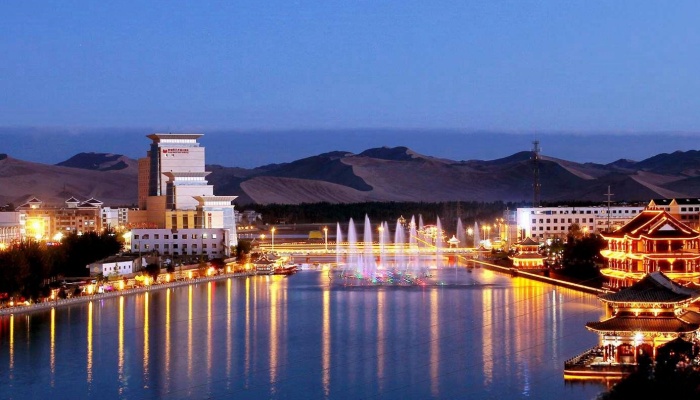
Location
Dunhuang City is located at the westernmost end of the Hexi Corridor, at the intersection of Gansu, Qinghai, and Xinjiang provinces (districts), with longitude ranging from 92 ° 42 ′ to 95 ° 30 ′ E and latitude ranging from 39 ° 38 ′ to 41 ° 34 ′ N. The total area of the city is 26700 square kilometers, of which the oasis area is 1991 square kilometers, accounting for only 7.18% of the total area.
Administrative Division
Dunhuang City governs 9 towns and 56 village committees. Shazhou Town is the location of the Municipal Party Committee and Municipal Government, and is the political, economic, and cultural center of the city. Qili Town, located 7 kilometers west of the city, is a new type of oil city.
Natural Environment
Within Dunhuang, there are three dangerous mountains to the east, Mingsha Mountain to the south, desert to the west, connected to the Taklamakan Mountains, and Gobi Desert to the north, connected to the remaining branches of the Tianshan Mountains. The total area of the city is 26700 square kilometers, of which the oasis area is 1991 square kilometers, accounting for only 7.18% of the total area. The average altitude is 1139 meters, the annual average precipitation is 42.2 millimeters, the evaporation is 2505 millimeters, the annual average temperature is 9.9 ℃, the highest temperature is 41.7 ℃, and the lowest temperature is -30.5 ℃. The annual average frost free period is 152 days, which belongs to a typical warm temperate arid climate.
Dunhuang Oasis is nourished by the Dang River, which originates from the Qilian Mountains. It has a total length of 390 kilometers, a drainage area of 16800 square kilometers, and an annual runoff of 302 million cubic meters. It is the mother river of the Dunhuang people. In addition to the Danghe River, there are also surface waters such as Xishuigou, Dongshuigou, and Nanhuquan in the area, with an annual runoff of 62 million cubic meters.
Population & Ethnicity
Dunhuang City is under the jurisdiction of Jiuquan City, with 9 towns and a total population of 200000, with an urbanization rate of 68.45%. The Han ethnic group accounts for the vast majority of the total population, while 27 ethnic minorities including Hui, Mongolian, Tibetan, Uyghur, Miao, Manchu, Tu, Kazakh, Dongxiang, and Yugu only account for 2.2% of the total population.
Tourism
There are 266 existing cultural relics and scenic spots in Dunhuang, including 3 world cultural heritage sites, namely Mogao Grottoes, Yumen Pass Site, and Hanging Spring Site; There are four national key cultural relics protection units, namely Mogao Grottoes, Yumen Pass Site, Hanging Spring Site, and the Great Wall within Dunhuang; 12 provincial-level cultural relics protection units; One municipal level cultural relic protection unit; There are 47 county-level cultural relics protection units. Especially the Mogao Grottoes, known as "cultural treasures," enjoy a high reputation both domestically and internationally. In 1987, they were listed on the UNESCO World Heritage List.
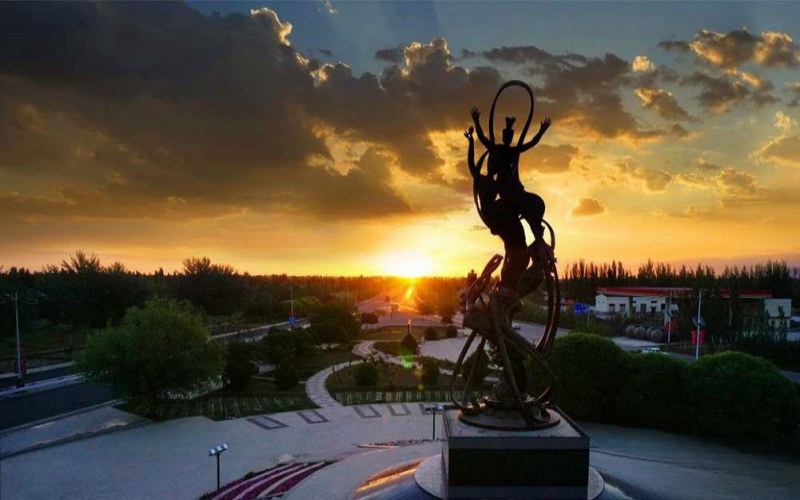
The Silk Road (Dunhuang) International Cultural Expo has permanently settled in Dunhuang and has been successfully held for six sessions. The "Dunhuang Culture Global Connection" activity continues to strengthen, and the dissemination and influence of Dunhuang culture continue to increase. In 2023, the city received 16.83 million tourists and generated a total tourism revenue of 15.6 billion yuan.
In Dunhuang, there are a total of 819 hotels and restaurants in the city, including 20 star rated hotels with a total of 50000 beds. There are 232 travel agencies in the city, including branch offices. There are currently 1340 tour guides in the city, covering six languages including English, Japanese, French, Korean, German, and Spanish. There are currently 786 tourist vehicles in the city.
Cultural Industry
There are currently 287 cultural industry operating units in the city, with business scope covering cultural tourism, audio-visual film and television, online culture, performing arts and entertainment, art training and other cultural industry systems, forming more than 3000 varieties of cultural tourism characteristic products in 12 categories such as jade, craft camels, woodcut paintings, etc. There are 11 intangible cultural heritage protection projects in the city, including 1 national level (Dunhuang Quzi Opera), 3 provincial level (Dunhuang folk songs, Dunhuang painted sculptures, and Paper Cuttings paper cuts), and 8 municipal level.
Urban Construction
The built-up area of Dunhuang City is 15.01 square kilometers, with an urbanization rate of 73.2%. Public leisure and entertainment venues such as Shazhou Amusement Park, Liyuan Square, Xiangyun Ecological Park, Xiangyun Square, Yingbin Square, Feitian Park, Dongcheng Lane Street Center Park have been built, covering an area of about 1693.38 acres. About 155.09 acres of green isolation belts and green corridors have been built, and 14580 trees of various types have been planted. The green coverage rate of urban built-up areas has reached 38.96%, the green coverage rate has reached 43.56%, and the per capita park green area has reached 14.63 square meters. In 2008, Dunhuang City was built into a provincial-level garden city.