
Daming Temple is located on the peak of Shugang in the northwest corner of Shouxi Lake in Yangzhou. It was named after its construction during the reign of Emperor Xiaowu of the Southern Song Dynasty (457-464 AD). The temple we see today was built during the reign of Emperor Tongzhi of the Qing Dynasty. Before Tang Dynasty monk Jianzhen sailed eastward to Japan, he passed on scriptures and taught precepts at Daming Temple, which made the temple famous.
What to See
The entire Daming Temple is divided into three parts: the central part is the main temple building, the eastern part is the Qiling Pagoda, and the western part is the garden style backyard - Xiyuan.
You can visit Quanmingming Temple in the order of central eastern western. Climbing up the mountain along the soothing steps - the mountain is not high, only 28 meters above sea level, and you arrive at the main entrance of Daming Temple.
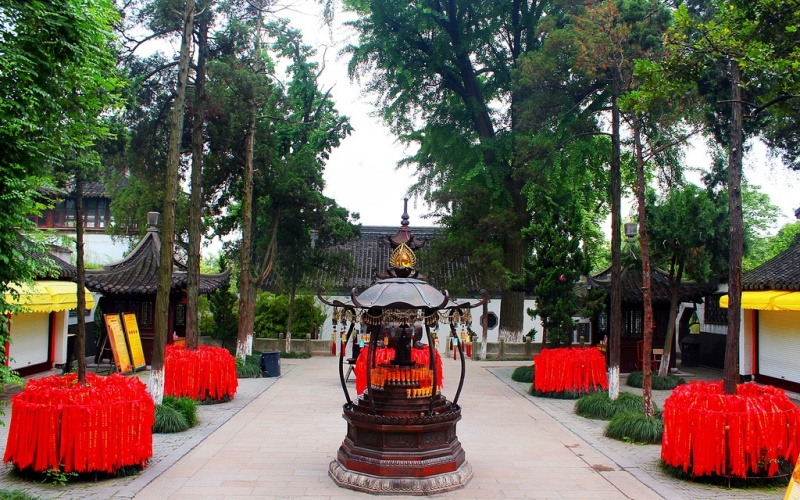
There are many vendors selling incense on both sides of the mountain road. Don't buy it, as incense from outside is not allowed to be brought into the temple. Please incense inside the temple. The main temple buildings in the middle of the scenic area are divided into three paths along a north-south direction.
On the central axis, from the south to the north, there are archways, gates that play the role of the Temple of Heavenly Kings, and the Shakya ManiHall.
On the west road, the main focus is on Ouyang Xiu. To the south is the Pingshan Hall built by Ouyang Xiu when he was the governor of Yangzhou. Later, when Su Dongpo was the governor of Yangzhou, he built the Gulin Hall behind the Pingshan Hall to commemorate Ouyang Xiu. To the north is the Ouyang Temple. To the south of the East Road,it is the abbot's mansion Pingyuan Building, and to the north is the Jianzhen Memorial Hall. To the east of the Jianzhen Memorial Hall is the scripture storage building.
The Jianzhen Memorial Hall is an important building of Daming Temple. Jianzhen traveled eastward six times and brought Chinese Buddhism and culture to Japan. He presided over the construction of Tang Zhaoti Temple in Nara, Japan and passed away there. The Jianzhen Memorial Hall was built in the 1960s and 1970s, imitating the appearance of Tang Zhaoti Temple. In the pavilion in front of the memorial hall stands a White Marble monument inscribed with "Monument to Great Monk Jianzhen of Tang Dynasty". There is a stone lantern in the center of the courtyard, which was given to the elders of Tang Zhaoti Temple in Japan. It is a pair with another stone lantern in Tang Zhaoti Temple.
There is a sitting statue of Jianzhen made of nanmu enshrined in the memorial hall, which is modeled after the Jianzhen statue in Tang Zhaoti Temple and looks like it when he passed away. The former Clear Sky Pavilion across from the memorial hall is now the Jianzhen Historical Materials Museum, where you can learn about Jianzhen's deeds through graphic and textual introductions.
The Qiling Pagoda in the eastern part of the scenic area was originally built by Emperor Yang Jian of the Sui Dynasty to celebrate his birthday. The tower we see now has been restored and rebuilt according to the tower of the Sui Dynasty. The tower is 9 stories high and houses relics and a Nanmu Buddhist pagoda. Climbing to the top of the tower, you can overlook the entire Daming Temple and overlook the scenery of Shouxi Lake and Yangzhou City.
The east and west sides of the Qiling Pagoda are respectively the Bell Tower and Drum Tower, and the Sleeping Buddha Hall to the north of the pagoda can see a jade Buddha from Myanmar. The West Garden, located in the western part of the scenic area, is also known as the Imperial Garden due to its association with Emperor Qianlong's visit to Jiangnan.
Like all other gardens in Jiangnan, the garden is lined with rockeries, pavilions, and towers, with a lake in the center serving as a release pond. There is a Qianlong Imperial Stele Pavilion on the east side of the lake, with three Qianlong Imperial Steles erected. There is the fifth spring in the world in the lake, which was evaluated by Zhang Youxin, the author of the Tang Dynasty's "Record of Fried Tea Water".
A little further south of the Qianlong Imperial Stele, you can see the "Fifth Spring" stele and an ancient well.On December 31st every year, Daming Temple holds a lively "Bell ringing New Year's Eve Ceremony".
The event takes place on New Year's Eve, and citizens in the temple pray for peace and good luck in the new year, accompanied by the 108 chimes of the midnight bell. On the birthdays and anniversaries of various bodhisattvas, Da Ming Temple also holds Buddhist ceremonies.
Travel Tips
Address:No. 8 Pingshantang East Road, Hanjiang District, Yangzhou City
Telephone:0514-87331089,0514-87340720
Opening Hours:From 08:00 to 16:30 throughout the year
Admission ticket:Peak season: CNY45 ; Off season: CNY30