
The Grand Canal, like the Great Wall, is one of the most magnificent and astounding creations in ancient China. Approximately 1,776 km, the Grand Canal is the longest man-made waterway in the world. Officially. its route runs from Beijing in the north to Hangzhou in the south, connecting to various river systems along the way.
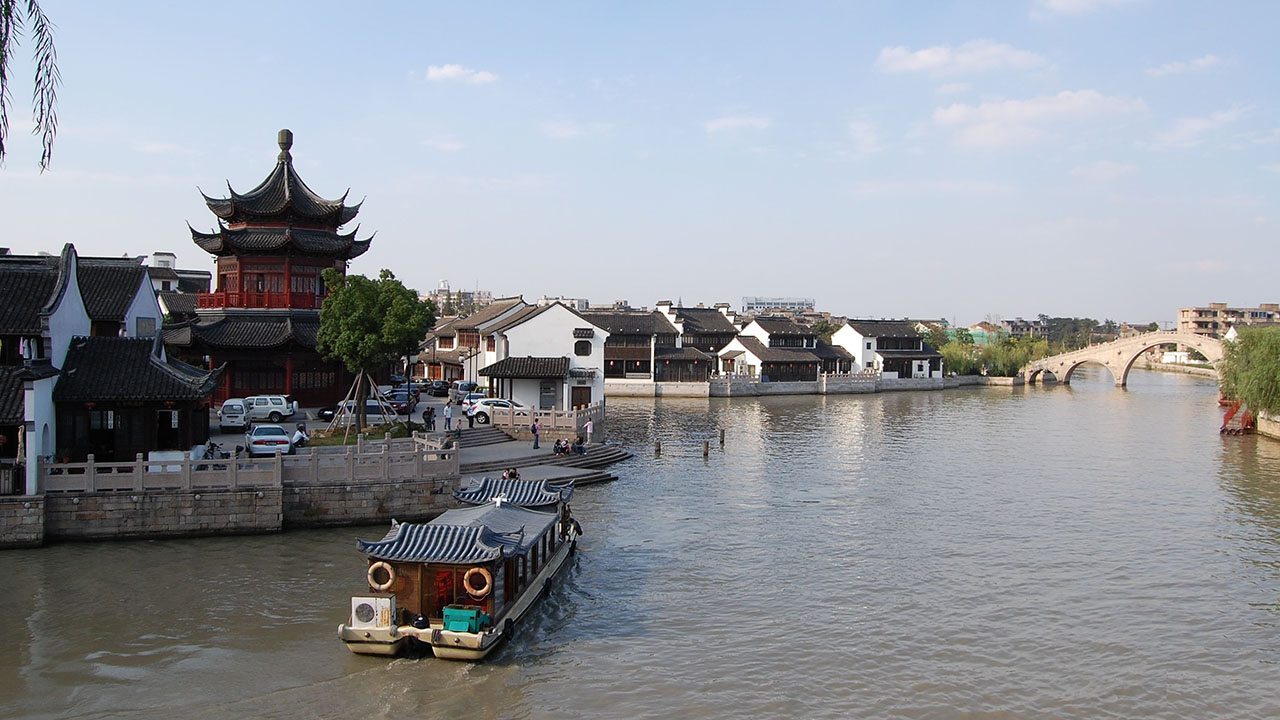
The world-famous Beijing-Hangzhou Grand Canal is an ancient grandeur project in the Eastern Plains. It is the earliest and longest manmade watercourse in the world. With an overall length of 1794 kilometers, the ancient Grand Canal started in Beijing in the north and reached Hangzhou in the south, flowing through 4 provinces and 2 cities of Beijing City, Hebei Province, Tianjin City, Shandong Province, Jiangsu Province and Zhejiang Province, and linking up the river systems of Haihe River, Yellow River, Huai River, Yangtze River and Qiantang River.

In the long history, the Grand Canal has made enormous contribution to the communication between North China and South China in both economy and culture.

The origins of the Grand Canal can be traced as far back as 495 B.C., making it more than 2,000 years old. With fifty-eight historically significant sites along its route, the entire Grand Canal has been declared a UNESCO World Heritage Site. From ancient dynasties to the present day, the Grand Canal continues to bolster Suzhou’s economy and industry, quite literally putting Suzhou on the map.
While much of the Grand Canal is no longer in use, various sections running through Suzhou can still be toured. More than 80 km of scenery and wonder flank the waterway, including hundreds of old-world river dwellings, ten ancient city gates, twenty-plus stone bridges and two of Suzhou’s crown jewels, Hanshan Temple and West Garden Temple. For an added treat, consider an evening boat tour to see the sights illuminated along its historic stretch.